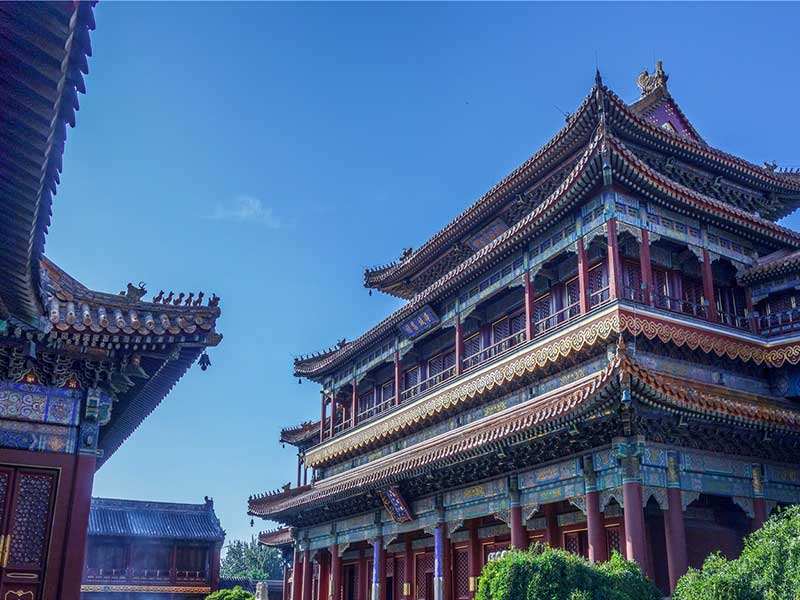
The Yonghe Lamasery, also known as Yonghe Temple or the Palace of Peace and Harmony, is Beijing's largest, most magnificent, and best-preserved Tibetan Buddhist temple. Located in the heart of the Dongcheng District, it serves as a vital center of Lamaism in North China and is a unique blend of Han Chinese and Tibetan architectural styles. Unlike most temples, it boasts an imperial origin, having once served as the residence of Emperor Yongzheng and the birthplace of Emperor Qianlong.
Key Highlights
Imperial Connection: Built in 1694 as the Prince Yong's Mansion for the future Emperor Yongzheng, it was converted into a lamasery in 1744 during Emperor Qianlong's reign. The use of yellow glazed roof tiles (reserved for emperors) signifies its royal status.
Architectural Fusion: The temple complex is a masterpiece of integration. While the layout follows the strict symmetry of Han Chinese palace architecture along a central axis, the decorations, murals, and statues reflect strong Tibetan Buddhist influences.
The Grand Maitreya Buddha: The most breathtaking sight is the 18-meter (59 ft) tall statue of Maitreya Buddha (the Future Buddha) housed in the Wanfu Pavilion. Carved from a single piece of precious white sandalwood, it is listed in the Guinness Book of World Records as the world's tallest wooden Buddha statue.
Layout & Must-See Spots
The temple stretches 480 meters from north to south and comprises five main halls:
The Hall of the Heavenly Kings: The entrance hall guarding the temple.
The Hall of Harmony and Peace (Yonghegong): The main hall featuring three large bronze Buddha statues.
The Hall of Everlasting Blessings: Known for its intricate Five-Hundred-Arhat Mountain carving.
The Hall of the Dharma Wheel: Where Buddhist teachings are studied; features a statue of Tsong Khapa, the founder of the Gelug school.
The Pavilion of Infinite Happiness (Wanfu Ge): Houses the colossal Maitreya Buddha statue.
Visitor Information
Location: 12 Yonghegong Street, Dongcheng District, Beijing.
Opening Hours:
April 1 - October 31: 09:00 - 16:30
November 1 - March 31: 09:00 - 16:00
Note: Last entry is usually 30 minutes before closing.
Tickets: Standard admission is approximately ¥25. Audio guides are available for rent.
Getting There:
Subway: The most convenient way is to take Line 2 or Line 5 to Yonghegong Station (Exit F).
Bus: Routes 13, 684, etc., to Yonghegong Station.
Tips for Visitors
Incense Offering: Visitors are usually given a bundle of free incense at the entrance. You can join locals in the ritual of burning incense to pray for peace and happiness.
Respect the Rules: Photography is generally prohibited inside the main halls where the statues are enshrined. Always walk around religious artifacts (such as prayer wheels) in a clockwise direction.
Combine Your Visit: It is located near the Confucius Temple and the Lama Temple Bridge (Yonghegong Bridge), making it perfect for a half-day cultural walk in the hutong area.