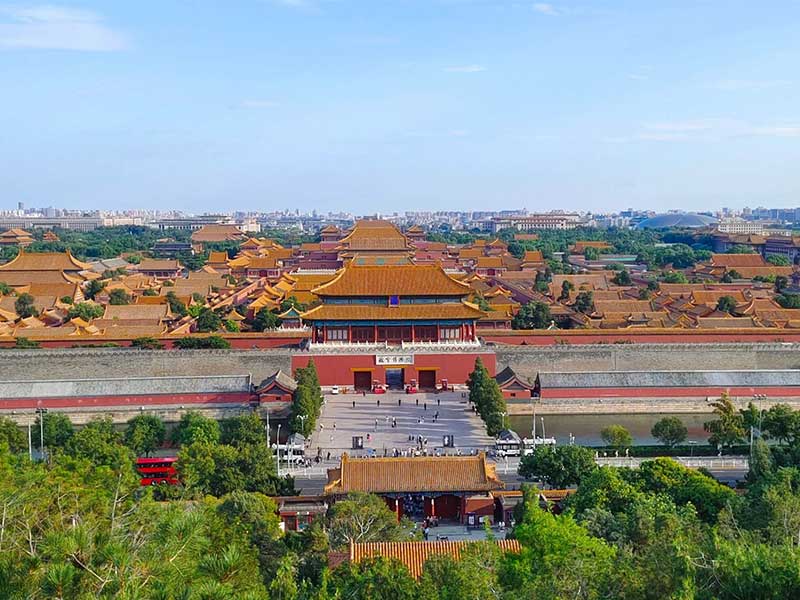
Jingshan Park, often referred to as Coal Hill, is a historic royal garden located just north of the Forbidden City in the heart of Beijing. Sitting atop the highest point of the Beijing Central Axis, it offers the most iconic bird's-eye view of the Forbidden City and the surrounding capital.
Key Highlights
Panoramic Views: The primary attraction is the view from the top of Jingshan Hill. The central pavilion, Wanchun Pavilion, provides a breathtaking vantage point to see the vast expanse of the Forbidden City's golden rooftops to the south and the modern Beijing skyline to the east.
Historical Significance: The hill was created during the Ming Dynasty using earth excavated from the digging of the moat surrounding the Forbidden City and nearby canals. It served as the imperial family's backyard for recreation and as a Feng Shui screen to protect the palace.
The End of the Ming Dynasty: The park is home to the infamous "Guilty Tree" (an ancient scholar tree) on the eastern slope, where Emperor Chongzhen, the last emperor of the Ming Dynasty, is said to have hanged himself in 1644 when the capital fell.
UNESCO World Heritage: In 2024, Jingshan Park was inscribed as a UNESCO World Cultural Heritage site as part of the "Beijing Central Axis."
Main Attractions
The Five Pavilions: The hill features five prominent peaks, each topped with an exquisitely designed pavilion: Zhoushang Pavilion, Guanmiao Pavilion, Wanchun Pavilion (central), Jifang Pavilion, and Fulan Pavilion.
Shouhuang Hall: Located to the north of the hill, this was the second-largest ancient architectural complex on the central axis (after the Forbidden City). It served as the imperial temple for the Qing emperors to display ancestral portraits and hold memorial ceremonies.
Qiwang Tower (Hall of Looking Out): Situated at the foot of the mountain, this building was originally used by students from the imperial school to worship Confucius.
Flower Seasons: The park is famous for its seasonal blooms, particularly the Peony Festival in late April to mid-May and the lotus blossoms in summer.
Visitor Information
Location: No. 44 Jingshan West Street, Xicheng District, Beijing (directly north of the Forbidden City's Gate of Divine Might).
Opening Hours:
April 1 - October 31: 06:00 - 21:00
November 1 - March 31: 06:30 - 20:00
Tickets: Admission is very affordable (approx. ¥2 for adults, ¥1 for students). You can usually buy tickets at the gate or online via the "Beijing Park Online" (畅游公园) platform.
Getting There:
On Foot: The most convenient way is to walk north directly from the Gate of Divine Might (Shenwumen) of the Forbidden City.
Bus: Routes 5, 58, 101, 103, 109, 111, 124, etc., to stops like "Shenwumen" or "Jingshan Dongmen."
Subway: Take Line 8 to Shichahai Station or Line 6 to Beihai North Station, then walk.
Tips for Visitors
Best Photo Ops: The view from Wanchun Pavilion is a must-capture. For the best lighting, go early in the morning (sunrise) or late in the afternoon (sunset).
Combine Your Visit: It is perfectly located for a northward stroll after visiting the Forbidden City. You can exit the Forbidden City through the north gate and walk straight into Jingshan Park.
Local Life: The park is a popular spot for locals to practice Tai Chi, sing Peking Opera, or dance, offering a glimpse into traditional Beijing lifestyle.